Showing posts with label aulora. Show all posts

Sunday, June 1, 2014

Otaku - A Diversity of People

As discussed in the first post, when the word 「おたく」was first put into use by Akio Nakamori, it was used to describe a very negative and very specific stereotype of individuals. Unkempt, foolish, withdrawn, awkward. For many people, this still seems to be the common conception upon hearing the word 「おたく」. 

However, my experience with おたく individuals could not have been more different. I had the opportunity to see and spend time with a variety of individuals who would be identified as おたく. Their situations were diverse, their personalities rich and unique. Today I would like to share just a few of those experiences with you all.

To start, let's look at a broad example and return to the classic おたくgathering point of Akihabara. However, each of these locations hosted a wide array of individuals. Young, old, various professional workers, students, male, female. There was no limit to the variety of people there.

The streets of Akihabara.

INTRO. ***This friend has always identified as an おたくfrom the start of our friendship. She passionately watches アニメ and reads 漫画, plays both Nintendo and Playstation games, and has a love for photographing cosplay. However, she is so far from the stereotype depicted by ****NAME. She is an active participant of her university's photography club, and has just begun the third year of her philosophy degree. And she is very stylish and good-looking!


Here is a nice really blurry photo from behind from which you will never guess her identity. I respect her privacy.

Though she is Japanese and lives in Japan, our friendship was born in the year she was studying abroad at my high school in Calgary! Honestly, she has done some incredible things! And more than that, her personality is delightful. She is easy to talk to, kind, fun, and well mannered. Upon first impression, I think many people would never suspect to hear her refer to herself as an おたく. But she is a prime demonstration of both burning おたくpassion and a rich and developed persona. 

Wait, no, I mean personality. I need to sleep. But please take this picture anyways.
I do not think she is the only individual like this. I have no doubt that there are many more おたく whose enthusiasm for their interests does not stop them from actively participating and enriching the world around them.

My final example, the father of my host family, is undeniably a true おたく, with the shelves of his room filled with manga, watching anime on Sunday mornings. But not only that, the mother of the family laughed with me that even though she wants to travel, the father never wants to go because he cannot read "Jump" magazine outside of the country haha. Furthermore, I experienced his manga knowledge first-hand when he took me to "Book Off" and gave me some recommendations...

しまった…

However, what stood out to me about him was not his passion for manga, but his passion for his family. He worked late throughout the week, but it was evident that on the weekend he let his love for his family overflow. Happily helping his son with homework on Saturday morning, dancing to Micheal Jackson with the mother, solving Professor Layton puzzles with the daughter, and even towards me, the honorary family member, watching anime and watching 嵐's variety shows with me (I love 嵐!) and proudly sharing stories and photos of his family. 

When people think negatively of おたく, I think they often look only at what they appear to be an irregularly strong interest, and forget the rest of the individual. But to me, this father was a powerful example of how おたく are also people, and can be full of such kindness and wonderfulness and goodness.

It seems I'm coming to the end of this blog. I'm not good at conclusions by any means, but I suppose if I could say one thing that I hope everyone could take from this post and this blog is to not look down on others due to their interests, or for any other reason. Each person has a story and it would be a shame to miss out on any of them. This blog is focused on おたく, and I certainly hope that people will apply this to them, but to all people, as well.

That's all I have to say! Thank you all for reading!

Anime Eyes Sleep Mask
And good night......

Sunday, May 25, 2014

Dress for Success, Cosplay - コスプレ

This post is written by Aulora and Peter.

This week, we will write a brief intro to Cosplay!


The practice of cosplay itself is not exclusively Japanese of course--con-goers in any country are surely aware of this fact. Indeed, its origin is not Japanese either. However, the word itself was concieved by Japanese reporter Nov Takahashi to describe what he saw at World Con in 1984. World Con, an annual science fiction convention, was held in Los Angeles that year, and by that time the practice of cosplay was well established among American Science Fiction con-goers. With the first documented instance of a costumed con-goer being Forrest J. Ackerman at Worldcon 1939 in New York, cosplay had already grown to be a flourishing component of Science Fiction conventions in America. As such, Takahashi was merely describing what he observed in a creative manner. The word he created, "cosplay" (コスプレ), is a portmanteau of the English words "costume" and "play." After reporting the American practice back to a Japanese audience, cosplay officially took off in Japan to be the widely popular activity that it is today! In particular, Cosplay is popular among Otaku audiences!


But what distinguishes Japanese cosplay from that in other areas? One prominent factor is that cosplay in many other parts of the world is a practice reserved exclusively for conventions. 

From Design Fest, Tokyo Big Sight

However, in Japan, this is not so!! Not only do congoers dress up, but there are cosplay establishments in which the staff dress up! For example, of course, maid cafes, prevalent in areas such as Akihabara and Shibuya, where the staff dress up!

Normally you aren't allowed to take photos of staff members in costume. But.. she happens to "conveniently" be in my shot!
Furthermore, people can cosplay freely in public!! Oh the expressive power!!!!! In areas such as Harajuku, people dress in elaborate clothes and fun costumes! In fact, at this point, it begins to overlap with fashion, reconciling the rejected with the trending. Personally, I find that quite an interesting concept!

For example, lolita fashion is quite common in Harajuku!


But other genres of cosplay include steampunk,


and of course, characters!!

Akemi Homura from the anime, Madoka Magica
So what if you want to try your own cosplay? Well, there are two main routes you can take.

First are the pre-manufactured costumes that are produced and sold with varying quality. They are mostly available online, although certain specialty shops may carry popular sets. This is an easy way to get a taste of cosplaying one of your favourite characters in a pinch.

A cosplay shop in Akihabara
Most cosplayers choose to create their own costumes though, often starting many months or even years before the intended convention to show it off at. These costumes themselves can be considered a work of art and much effort and money is put towards created magnificent costumes. Skilled cosplayers often require many skills such as sewing, painting, fashion design, textiles, and even work with materials such as wood and fiberglass, to create more difficult and high quality representations.

Be careful of the convention rules however. Some of them do not allow props that resemble real weapons for security reasons. You don't want to get in trouble with the police just because your character looks dangerous!

We hope that you enjoyed this small glimpse into the wonders of cosplay, and perhaps even take part yourself someday!

Sunday, May 18, 2014

The subtle ambience of Akihabara / 秋葉原の雰囲気

Akihabara (秋葉原, shortened to Akiba or sometimes AKB) is a large district in Tokyo which has gotten the reputation of being home to both local and foreign otaku as well as average consumers of unique Japanese media. Of course, as legitimate gaikokujin, we had to explore it for ourselves. But Akihabara is not just a hub of self-labelled geeks and fans; rather, it's a common ground where people with unique interests can satisfy their inner love for their favorite media without being judged or berated.

In modern times, a lot of different kinds of people hang out in Akihabara. While there is a clear blend of both foreigners—many of whom self-identify as otaku—and Japanese natives, there's a lot more to it. Since Akihabara serves every kind of media from books to costumes, you can expect a different crowd on every corner!
Around two dozen Yu-Gi-Oh! fans play their hardest in the basement of an Akihabara trading card store.
Of course, contrary to what one might expect, most fans and avid enthusiasts do not stand out in a crowd. Every aisle of every store is populated with a few people at least, but to an average passer-by, nothing looks out of the ordinary.
Two ordinary manga fans check out their favorite section of an 8-floor media store.
Akihabara itself is destined to welcome otaku of every kind. Even foreigners can feel right at home, regardless of their interests!
This particular part of Akihabara draws gamers and technology enthusiasts alike.
As one might expect, however, most people in Akihabara keep to themselves, and their use of unique language is minimal in this crowded place. However, one unique trait does stand out: the majority of Japanese natives use an outstanding number of English loanwords when talking about locations and merchandise in Akihabara. Usage of 店 (みせ, "store, shop") and 〜屋 (〜や, "[something] shop") are minimal and the term ショップ is instead common. Another very common example is the use of the term コミック instead of 漫画 (まんが, "comic, cartoon"). As someone learning Japanese, you can get a lot of practice reading katakana and hearing English loanwords by simply wandering through Akihabara!

Akihabara hosts a wide variety of shops, as well.

Idol cafe?
Got it!

Cosplay shops?
Got those, too!

Manga shops?
Got 'em!

Game shops?
Even got those!

Arcades?
There's those too! But taking pictures within was not okey-dokey. Instead, please accept this artistic rendition!

Furthermore, though each of these stores may initially seem small, almost all of them extend upwards into multiple levels. It's like climbing the stairway into an infinite haven of your favourite hobby. If you plan on seriously going, it's probably best to take a full day.
Doesn't look like there are any maid cafes around... [Source: History of Akihabara]
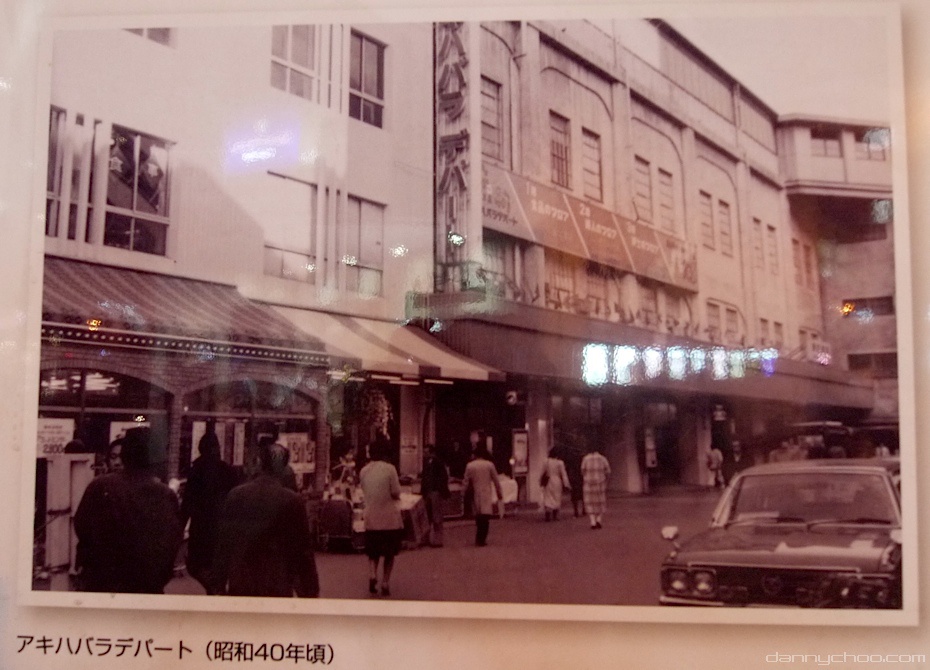
But once upon a time, Akihabara was much different. Akiba no Hara was located by the Kanda river and thus could easily connect to Tokyo Bay. As such, it was a very convenient location for trade. Originally designated as a freight exclusive station, in 1925, passengers were also allowed access. Many wholesalers took up residence and the area transformed to a fruits and vegetables market. However, after Japan lost the war in 1945, Japanese radio technicians and electronic engineers returned from their stations abroad and began to collect in the area to sell electronics. Eventually, the range of goods sold grew to include "white goods" (such as fridges and dishwashers), then personal computers when they emerged, then music, then games. As such, it grew to be the electronic and pop culture marketplace it is today.

Of course, by this point my good readers have probably realized that "Akihabara" and "Akiba no Hara" are not the same word. So how did "Akihabara" come into usage? As far as my research tells, simply by mistake. Somewhere along the line of the areas development, 「あきばのはら」"Akiba no Hara" was miswritten as the very similar-looking「あきはばら」"Akihabara." Perhaps a certain language group might find that interesting. But I digress.

Akihabara has gone from a quaint field to a bustling and lively hotspot where people can come from all around the world to experience their favorite Japanese media. It will be fascinating to see where else Akihabara goes from here!

Monday, May 12, 2014

Training to be a Train Otaku / What is a 鉄道おたく?

A 電車おたく or 鉄道おたくis someone who is extremely enthusiastic about trains, often to the point of knowing numerous statistics and models such as top speed, maximum number of passengers, and the best place to take train pictures. Frequently 鉄道おたく gather at specific locations to take pictures of trains, either to keep, or to exchange with other otaku on otaku message boards like 2ch, pronounced にーちゃんねる.

鉄道, translating to "railway" is composed of the Kanji 鉄 (てつ) meaning "iron," and 道 (どう) meaning "way."

鉄 is the same kanji used to refer to iron content within the body, so a 鉄道おたくmight joke like "I have an iron deficiency because I haven't ridden a train for two weeks."

鉄道おたくare not solely found in Japan, and are called by different names in other countries. Some such names include "railway buff," "railfan," and "trainspotter" in countries such as Australia, America, and England.

Another example of a 鉄道おたくin another country who saw some internet fame is Jay Tan, a self-professed 鉄道おたく from Singapore. In 2011 upon the opening of the Circle Line, Jay Tan was one of the few individuals taking the first ride on the train early that Saturday morning. He was interviewed, and the video gained quite a bit of popularity on the internet.
"I am too excited, could not sleep last night. I want to board the first train."
Though not Japanese, Jay Tan is a prime example of a 鉄道おたく!