In modern times, a lot of different kinds of people hang out in Akihabara. While there is a clear blend of both foreigners—many of whom self-identify as otaku—and Japanese natives, there's a lot more to it. Since Akihabara serves every kind of media from books to costumes, you can expect a different crowd on every corner!
 |
| Around two dozen Yu-Gi-Oh! fans play their hardest in the basement of an Akihabara trading card store. |
 |
| Two ordinary manga fans check out their favorite section of an 8-floor media store. |
 |
| This particular part of Akihabara draws gamers and technology enthusiasts alike. |
Akihabara hosts a wide variety of shops, as well.
Idol cafe?
 |
| Got it! |
Cosplay shops?
 |
| Got those, too! |
Manga shops?
 |
| Got 'em! |
Game shops?
 |
| Even got those! |
Arcades?
 |
| There's those too! But taking pictures within was not okey-dokey. Instead, please accept this artistic rendition! |
Furthermore, though each of these stores may initially seem small, almost all of them extend upwards into multiple levels. It's like climbing the stairway into an infinite haven of your favourite hobby. If you plan on seriously going, it's probably best to take a full day.
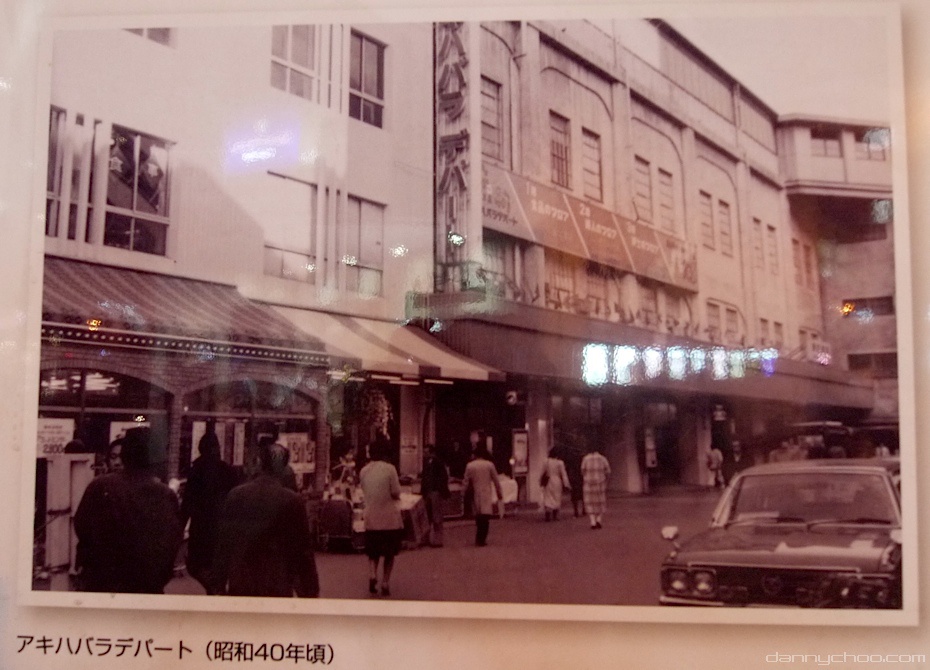 |
| Doesn't look like there are any maid cafes around... [Source: History of Akihabara] |
But once upon a time, Akihabara was much different. Akiba no Hara was located by the Kanda river and thus could easily connect to Tokyo Bay. As such, it was a very convenient location for trade. Originally designated as a freight exclusive station, in 1925, passengers were also allowed access. Many wholesalers took up residence and the area transformed to a fruits and vegetables market. However, after Japan lost the war in 1945, Japanese radio technicians and electronic engineers returned from their stations abroad and began to collect in the area to sell electronics. Eventually, the range of goods sold grew to include "white goods" (such as fridges and dishwashers), then personal computers when they emerged, then music, then games. As such, it grew to be the electronic and pop culture marketplace it is today.
Of course, by this point my good readers have probably realized that "Akihabara" and "Akiba no Hara" are not the same word. So how did "Akihabara" come into usage? As far as my research tells, simply by mistake. Somewhere along the line of the areas development, 「あきばのはら」"Akiba no Hara" was miswritten as the very similar-looking「あきはばら」"Akihabara." Perhaps a certain language group might find that interesting. But I digress.
Akihabara has gone from a quaint field to a bustling and lively hotspot where people can come from all around the world to experience their favorite Japanese media. It will be fascinating to see where else Akihabara goes from here!

No comments:
Post a Comment