Sunday, May 25, 2014

Dress for Success, Cosplay - コスプレ

This post is written by Aulora and Peter.

This week, we will write a brief intro to Cosplay!


The practice of cosplay itself is not exclusively Japanese of course--con-goers in any country are surely aware of this fact. Indeed, its origin is not Japanese either. However, the word itself was concieved by Japanese reporter Nov Takahashi to describe what he saw at World Con in 1984. World Con, an annual science fiction convention, was held in Los Angeles that year, and by that time the practice of cosplay was well established among American Science Fiction con-goers. With the first documented instance of a costumed con-goer being Forrest J. Ackerman at Worldcon 1939 in New York, cosplay had already grown to be a flourishing component of Science Fiction conventions in America. As such, Takahashi was merely describing what he observed in a creative manner. The word he created, "cosplay" (コスプレ), is a portmanteau of the English words "costume" and "play." After reporting the American practice back to a Japanese audience, cosplay officially took off in Japan to be the widely popular activity that it is today! In particular, Cosplay is popular among Otaku audiences!


But what distinguishes Japanese cosplay from that in other areas? One prominent factor is that cosplay in many other parts of the world is a practice reserved exclusively for conventions. 

From Design Fest, Tokyo Big Sight

However, in Japan, this is not so!! Not only do congoers dress up, but there are cosplay establishments in which the staff dress up! For example, of course, maid cafes, prevalent in areas such as Akihabara and Shibuya, where the staff dress up!

Normally you aren't allowed to take photos of staff members in costume. But.. she happens to "conveniently" be in my shot!
Furthermore, people can cosplay freely in public!! Oh the expressive power!!!!! In areas such as Harajuku, people dress in elaborate clothes and fun costumes! In fact, at this point, it begins to overlap with fashion, reconciling the rejected with the trending. Personally, I find that quite an interesting concept!

For example, lolita fashion is quite common in Harajuku!


But other genres of cosplay include steampunk,


and of course, characters!!

Akemi Homura from the anime, Madoka Magica
So what if you want to try your own cosplay? Well, there are two main routes you can take.

First are the pre-manufactured costumes that are produced and sold with varying quality. They are mostly available online, although certain specialty shops may carry popular sets. This is an easy way to get a taste of cosplaying one of your favourite characters in a pinch.

A cosplay shop in Akihabara
Most cosplayers choose to create their own costumes though, often starting many months or even years before the intended convention to show it off at. These costumes themselves can be considered a work of art and much effort and money is put towards created magnificent costumes. Skilled cosplayers often require many skills such as sewing, painting, fashion design, textiles, and even work with materials such as wood and fiberglass, to create more difficult and high quality representations.

Be careful of the convention rules however. Some of them do not allow props that resemble real weapons for security reasons. You don't want to get in trouble with the police just because your character looks dangerous!

We hope that you enjoyed this small glimpse into the wonders of cosplay, and perhaps even take part yourself someday!

The rise of the ヲタ / ヲタのようになる

Japan hosts a wide variety of otaku, of which many are infamous. In the West, people commonly think of an otaku as one who enjoys anime and manga. While there are anime and manga otaku in Japan, it's not uncommon to find, for example, train and camera otaku as well, especially in Akihabara. However, in the upper-middle part of the spectrum lie idol otaku, who generally obsess over the latest idol or pop bands and records.

The idol otaku subgroup is a very distinct community, even among other otaku. AKB48, for example, has a cafe which stands out even in Akihabara, a place known for its dozens and dozens of various hobby and esoteric shops.
AKB48, having its own cafe, is one of the most popular idol brands.
The idol otaku subculture has even coined a specific term, ヲタ, which describes an idol otaku. (In the West, this is usually pronounced "WOE-tah", whereas the Japanese pronounce it more correctly as オタ ota.) This term is derived from the first two syllables of the term おたく, then stylized with an identically sounding, but archaic, character. Though it is derived from the term otaku, it is generally used to refer only to idol otaku, not others (anime, manga, train, etc.).
Akihabara and Shibuya specifically feature Tower Records, a very widely known record company. After all, no music means no life!
Idol brands, due to being so influential (both within and outside of the idol otaku community), are often used to sell other merchandise brands. For example, AKB48 (as mentioned above) was featured in a candy commercial several years ago. This popularity often plays on the 推しメン mentality, which has fans buy things because of the attachment to their favorite idol.
Like idols, anime and manga characters are often used to sell products or entire brand lines.
推しメン comes from the term 推し oshi, meaning "a fan of", and メン men, which (in context) is short for メンバー menbaa, from the English word "member". It generally refers to a fan's favorite member of a particular idol group.

While Candies (キャンディーズ) is widely considered to be the first idol group in the 1970's, the current idol formula started in the late 1990s with the success of hello!project and Morning Musume's song "Love Machine" which gained mainstream success and sold almost 1.7 million copies, making it a #1 single in Japan.

At this same time, as the internet otaku community took off online, and obsessive fans began messaging each other to progress their undying love for a particular idol, compare recent idol purchases and the like. The specific evolution of idol otaku and the term ヲタ was centered around online message boards such as 2ch's Morning Coffee, in an attempt to distinguish themselves from anime otaku.

While the following Morning Musume singles also had mainstream success, the general public moved on to other artists and other types of music. Because of this, wota have for a long time been the main target of idol groups, leading to policies such as no dating (with several idols being 'graduated' after a dating scandal, and effectively banned from ever performing again), handshake events, and lottery-style giveaways that rewarded otaku for buying multiple copies of a single.

A specific example is with the release of a recent AKB48 single, "Everyday, Kachuusha". One particular fan bought over 5,500 copies of the single in order to attend such lottery-style events. Generally, the paychecks of idol otaku, who are as dedicated as this one, are put largely toward such purchases.
An unnamed idol otaku has hoarded thousands of copies of a newly released AKB48 single. [Source]
As obsessive fans, wota memorize their chosen idol's birthday, height, blood type and favorite color. At concerts, wota purchase glow sticks in their idol's chosen color, and memorize a set dance for each song. These dances are called ヲタ芸 wotagei, and are a unique form of audience participation present only at idol concerts.


The idol otaku subculture has grown massively in the last several years, especially with the rise of the internet. Such a medium has provided the ability to stream and download music, watch idol-related videos through services such as YouTube, or even connect with other like-minded idol otaku. Because of the improving ease of communication within this group, their unique language and culture has grown immensely, and shows no signs of slowing down.

Sunday, May 18, 2014

Moe moe kyun~! / 萌え 萌え きゅん~!

This post is written by Peter and Sarah.

Those who are familiar with otaku culture will already know the term moe (萌え) as a natural concept. Those outside are often confused with the definition and the obsession over this slang term. The term itself is hard to define and there are various definitions of it. There's no denying the huge influence it has had on otaku culture though.

The most common definition for moe refers to a particular feeling one gets towards a fictional or non-fictional character. It may be directed towards a particular character or a characteristic archetype (more on this later). In general, it stands for "cuteness" or "adorableness" rather than sexual attraction, but that can vary depending on the otaku. Other definitions include a "pure protective feeling" akin to a parental relationship towards their children. The definition is intentionally vague, because otaku culture itself varies, and different otaku will consider different things to be moe.


Nomura Research Institute defined the slang word as a pun from the word 萌える (moeru), meaning "to bloom, or budding", as moe characters are usually young and developing characters rather than more mature ones. Another source may have been 燃える (moeru), meaning "to burn", where your heart is "burning for passion". The physical feeling that some claim they get from moe is similar to the feeling of wanting to cuddle an adorable kitten or puppy upon first sight. 

Characters commonly defined as moe today are typically young, cute, and innocent girls. Otakus are usually attracted to a specifc character archetype rather than specific characters, but some otaku claim to fall in love with a character and declare them as their "waifu". This is the 4chan definition of waifu (NSFW Language and content warning). This is a primarily western otaku term, but Japanese have a similar concept with some extreme cases participating in  嫁との晩餐 (yome to no bangohan, lit. dinner with wife), where otaku celebrate holidays with their virtual partner.
An otaku celebrating Christmas with their virtual "waifu".

Here are some other popular archetypes:
  • Tsundere (ツンデレ) - A character that is initially hostile and cold (tsun tsun ツンツン, meaning turning away in disgust) , but slowly warms up and shows their warmer side (dere dere デレデレ, meaning lovey-dovey).
  • Yandere (ヤンデレ) - A character that appears perfectly innocent and charming at first, but are actually obsessive or controlling towards their love interest, often showing insanity episodes invoked by jealously.
  • Meganekko (眼鏡っ娘) - Literally means glasses-wearing girls. While their glasses are the main focus, these characters are usually quiet and sweet, but very smart and pleasant.
  • Kemonomimi (獣耳) - Characters with animal features, such as cat ears (nekomimi 猫耳), fang teeth, and tails.
  • Imouto (妹) - Characters that fit strongly into the little sister/big brother dynamic, often going into the incestual territory.
  • Zettai Ryouiki (絶対領域) - Not a specific character type, but referring to the bare skin between the skirt and knee high socks.
  • And much more including maid (メイド), shrine maiden (巫女, miko), loli, energetic girl (元気), clumsy girl, etc.
Rin from Fate/Stay Night is the standard go-to tsundere example.

'Moe points' give otaku the chance to gather and discuss their favorite charm points and characters. As otaku are traditionally solitary creatures, outside of otaku conventions most of this discussion happens on online boards like 2ch, where topics (スレ - threads in 2ch parlance) discussing top ten moe characters, debate over which characters are or aren't moe, or which moe point is best are common. As moe has continued to gain traction in the otaku community, animators and マンガ家 (mangaka - creators of manga) have started to intentionally target this part of otaku culture. Some people even say that moe has taken over the industry, because it is easy to market and can reach wider audiences than the age-old "sex sells" advertising.

Moe sells.
Moe is also gradually beginning to spread throughout Japanese culture. The other day, a Japanese female friend (and definitely not an Otaku) complimented Sarah as "めっちゃ萌える" and described it as meaning "ridiculously cute." Another Japanese woman stated that most young Japanese people knew the word and what it meant in the otaku culture, but would almost certainly never use it because of the negative view of otaku.  Using "moe" in the sense of cute associates someone with otaku culture, so it's likely that the vast majority of people will describe someone as かわいい even if referring to typically 萌え features such as fang-teeth or glasses. However, even if the terms aren't directly used, it is certainly more prevalent in everyday culture as a cute way of attraction attention.

A poster from the Kyoto Municipal Subway's Moe Moe Project.

The subtle ambience of Akihabara / 秋葉原の雰囲気

Akihabara (秋葉原, shortened to Akiba or sometimes AKB) is a large district in Tokyo which has gotten the reputation of being home to both local and foreign otaku as well as average consumers of unique Japanese media. Of course, as legitimate gaikokujin, we had to explore it for ourselves. But Akihabara is not just a hub of self-labelled geeks and fans; rather, it's a common ground where people with unique interests can satisfy their inner love for their favorite media without being judged or berated.

In modern times, a lot of different kinds of people hang out in Akihabara. While there is a clear blend of both foreigners—many of whom self-identify as otaku—and Japanese natives, there's a lot more to it. Since Akihabara serves every kind of media from books to costumes, you can expect a different crowd on every corner!
Around two dozen Yu-Gi-Oh! fans play their hardest in the basement of an Akihabara trading card store.
Of course, contrary to what one might expect, most fans and avid enthusiasts do not stand out in a crowd. Every aisle of every store is populated with a few people at least, but to an average passer-by, nothing looks out of the ordinary.
Two ordinary manga fans check out their favorite section of an 8-floor media store.
Akihabara itself is destined to welcome otaku of every kind. Even foreigners can feel right at home, regardless of their interests!
This particular part of Akihabara draws gamers and technology enthusiasts alike.
As one might expect, however, most people in Akihabara keep to themselves, and their use of unique language is minimal in this crowded place. However, one unique trait does stand out: the majority of Japanese natives use an outstanding number of English loanwords when talking about locations and merchandise in Akihabara. Usage of 店 (みせ, "store, shop") and 〜屋 (〜や, "[something] shop") are minimal and the term ショップ is instead common. Another very common example is the use of the term コミック instead of 漫画 (まんが, "comic, cartoon"). As someone learning Japanese, you can get a lot of practice reading katakana and hearing English loanwords by simply wandering through Akihabara!

Akihabara hosts a wide variety of shops, as well.

Idol cafe?
Got it!

Cosplay shops?
Got those, too!

Manga shops?
Got 'em!

Game shops?
Even got those!

Arcades?
There's those too! But taking pictures within was not okey-dokey. Instead, please accept this artistic rendition!

Furthermore, though each of these stores may initially seem small, almost all of them extend upwards into multiple levels. It's like climbing the stairway into an infinite haven of your favourite hobby. If you plan on seriously going, it's probably best to take a full day.
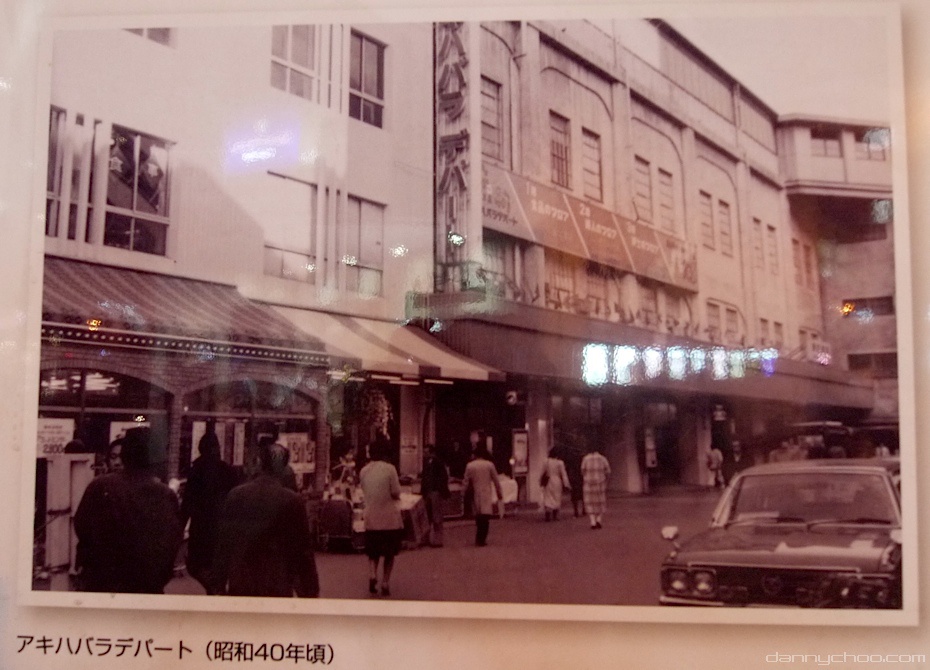
Doesn't look like there are any maid cafes around... [Source: History of Akihabara]
But once upon a time, Akihabara was much different. Akiba no Hara was located by the Kanda river and thus could easily connect to Tokyo Bay. As such, it was a very convenient location for trade. Originally designated as a freight exclusive station, in 1925, passengers were also allowed access. Many wholesalers took up residence and the area transformed to a fruits and vegetables market. However, after Japan lost the war in 1945, Japanese radio technicians and electronic engineers returned from their stations abroad and began to collect in the area to sell electronics. Eventually, the range of goods sold grew to include "white goods" (such as fridges and dishwashers), then personal computers when they emerged, then music, then games. As such, it grew to be the electronic and pop culture marketplace it is today.

Of course, by this point my good readers have probably realized that "Akihabara" and "Akiba no Hara" are not the same word. So how did "Akihabara" come into usage? As far as my research tells, simply by mistake. Somewhere along the line of the areas development, 「あきばのはら」"Akiba no Hara" was miswritten as the very similar-looking「あきはばら」"Akihabara." Perhaps a certain language group might find that interesting. But I digress.

Akihabara has gone from a quaint field to a bustling and lively hotspot where people can come from all around the world to experience their favorite Japanese media. It will be fascinating to see where else Akihabara goes from here!

Monday, May 12, 2014

Training to be a Train Otaku / What is a 鉄道おたく?

A 電車おたく or 鉄道おたくis someone who is extremely enthusiastic about trains, often to the point of knowing numerous statistics and models such as top speed, maximum number of passengers, and the best place to take train pictures. Frequently 鉄道おたく gather at specific locations to take pictures of trains, either to keep, or to exchange with other otaku on otaku message boards like 2ch, pronounced にーちゃんねる.

鉄道, translating to "railway" is composed of the Kanji 鉄 (てつ) meaning "iron," and 道 (どう) meaning "way."

鉄 is the same kanji used to refer to iron content within the body, so a 鉄道おたくmight joke like "I have an iron deficiency because I haven't ridden a train for two weeks."

鉄道おたくare not solely found in Japan, and are called by different names in other countries. Some such names include "railway buff," "railfan," and "trainspotter" in countries such as Australia, America, and England.

Another example of a 鉄道おたくin another country who saw some internet fame is Jay Tan, a self-professed 鉄道おたく from Singapore. In 2011 upon the opening of the Circle Line, Jay Tan was one of the few individuals taking the first ride on the train early that Saturday morning. He was interviewed, and the video gained quite a bit of popularity on the internet.
"I am too excited, could not sleep last night. I want to board the first train."
Though not Japanese, Jay Tan is a prime example of a 鉄道おたく!

Sunday, May 11, 2014

The reality of otaku in Japan / 日本でオタクの本当


The Japanese have a very different viewpoint of the term otaku than we may be used to. In the West, due to the popularity of Japanese culture and all their awesome stuff, people usually self-define as otaku if they enjoy Japanese media, specifically manga or anime, even if such media are consumed in English through translations. However, in Japan, the term is much more derogatory and is almost akin to the term hikikomori (引きこもり, lit. shut-in).

The Japanese population portrays otaku with a negative image as a burden to society, and they are generally disliked and shunned. This term is used to classify a subgroup of people who have poor social skills, and stays indoor everyday playing games or watching anime, which gives them their analogous hikikomori name. Their only forms of communication are generally online through text boards and image boards (like 2ch) where they usually post anonymously. Some of them also do not work or study formally, giving them the classification of ニート (NEET: Not in Education, Employment, or Training). Japan has a major problem with NEETs right now, particularly in the 18-35 age group who still live off their parents, so it's no wonder why this sub-population known as otaku are looked down upon by society.
Boards such as 2ch are often filled with anonymous otaku posts and otaku-slang-filled content.
With Japan having a very respectful and traditional culture, going against the norm in Japan is considered strange by the majority, so certain otaku behavior may also give them a negative and weird image. Even foreign perspectives on modern Japan focuses on some of the more ecstatic behaviours that doesn't reflect the hard-working and serious population as a whole. A newer definition of the term otaku that some younger people use refers to those who are passionate about their hobbies, and are not afraid to show it off. It doesn't have to be disruptive or flashy, but their dedication to their hobby is clear. This is the definition that is most neutral, and can cover the most extreme examples as well as more subtle cases.

Many students in Japan enjoy media such as light novels without being considered otaku.
In the West, people have redefined what an otaku is. Instead of being shut-ins, otaku in the West are often simply lovers of anime and manga. Though, while one otaku may read or watch a handful of manga or anime, another may watch over 9000 episodes of anime per day (okay, maybe not quite that many). This behavior borders on that of a weeaboo (a slang term for a Japanophile). However, even in such cases, these otaku are rarely as secluded as Japanese otaku; while they may lack a significant social life, they usually attend school, have other commitments, or even somehow maintain a relationship.

Because of the positive light in which Western otaku portray themselves and other otaku, it is often seen as an exclusive “club” in which non-otaku are not welcomed, and are thusly treated as outsiders. People in this “club” will sometimes even go out of their way to buy anime-related merchandise (like figurines, posters, etc.), even if they aren’t really collectors, simply to keep their standing among other otaku.

The varying definitions of the term otaku result in a very different interpretation of our blog topic. Due to our roots, the topic we had in mind is skewed towards the Western definition, but it will be interesting to keep the Japanese definition in mind when researching more information about it while we are here in Japan.

Thursday, May 1, 2014

The meaning of “otaku” / 「オタク」の意味

ようこそ!

This is our Senshu Otaku blog. While staying in Japan during the spring of 2014, we will be looking at various aspects of otaku culture and focusing on important words. Otaku is a term that goes all the way back to the 1980’s in Japan. It describes someone with a passionate or obsessive interest in something. Otaku of a similar mind often group together to discuss their interests. In this way, we have anime otaku, manga otaku, idol otaku, computer otaku, and even otaku interested in things such as trains, cars, cameras, and history. These grouping form the basis of otaku culture, and each group has its own slang and use of language.
Otaku are often portrayed in media such as anime and manga as well.
The term 「おたく」is derived from the word 「お宅」(おたく), a formal term meaning “you” or “your home.” There are a few ideas about how the original word came into usage as a name for this group of people, which, in fact, is an interesting reflection of the various perspectives on おたく culture itself.

For example, some believe that the term refers to individuals identified as おたく typically remaining within their own home, and stems from a negative perspective of おたく that sees them as shut-ins. This type of perspective of おたく is unfortunately quite typical in mainstream Japanese culture.

However, the historical origin of the word appears to be different. The term 「お宅」was originally used among fans and members of clubs. There are a few explanations for this usage. One is that it was used at conventions out of respect for other individuals’ clubs. Another is that it was started by Macross creators Shoji Kawamore and Haruhiko Mikimoto; these two individuals attended the upper-class Keio University in the same years, and addressed one another with the more refined term 「お宅」 instead of 「あなた」. Fans caught on and began to use 「お宅」out of respect for these studio creators, and eventually towards one another. Yet another explanation is that fans used it in direct imitation of Hikaru Ichijoe, the main character of Macross, who used the term to address other characters.

Journalist Akio Nakamori was the first to use 「おたく」 as a label for this group of people in 1983 in his article 「街には『おたく』がいっぱい」 ("This City is Full of Otaku") and subsequent writings. The article portrayed a very negative stereotype of anime and manga fans at conventions, and the term 「おたく」 was chosen to reference their overly-formal usage of the word 「お宅」.
Sept. 2008 Location: Akihabara, Tokyo, Japan © Kalandrakas | www.jessleecuizon.com | CC BY-NC-ND 2.0
The plan for this blog will be to look into various aspects of おたく culture, and the type of language they use. Posts may focus on a certain term, the meaning of it, its origins, and how it reflects that particular おたく subculture. Some of the subcultures that we plan to focus on are the Idol Otakus, Anime Otakus, Cosplay Otakus, and what we call Western Otakus. However, because there are many more types, there may be additional coverage based on what we see once we are over there.

By exploring popular おたく areas such as 秋葉原 (Akihabara), maid cafes, idol concerts and the like and interviewing people, as well as using our previous knowledge, we will use this blog to explain those important parts of おたく culture!